Sleep Anxiety
Breathing Exercises Make Me More Anxious at Night. What Should I Do?
Written by Samuel Michelot. Reviewed by Pilar Hostaled, registered psychologist. · Last updated September 2026
Quick answer
Breathwork helps many people sleep, but for some it increases body monitoring and anxiety. Here is why it happens and what to try instead.
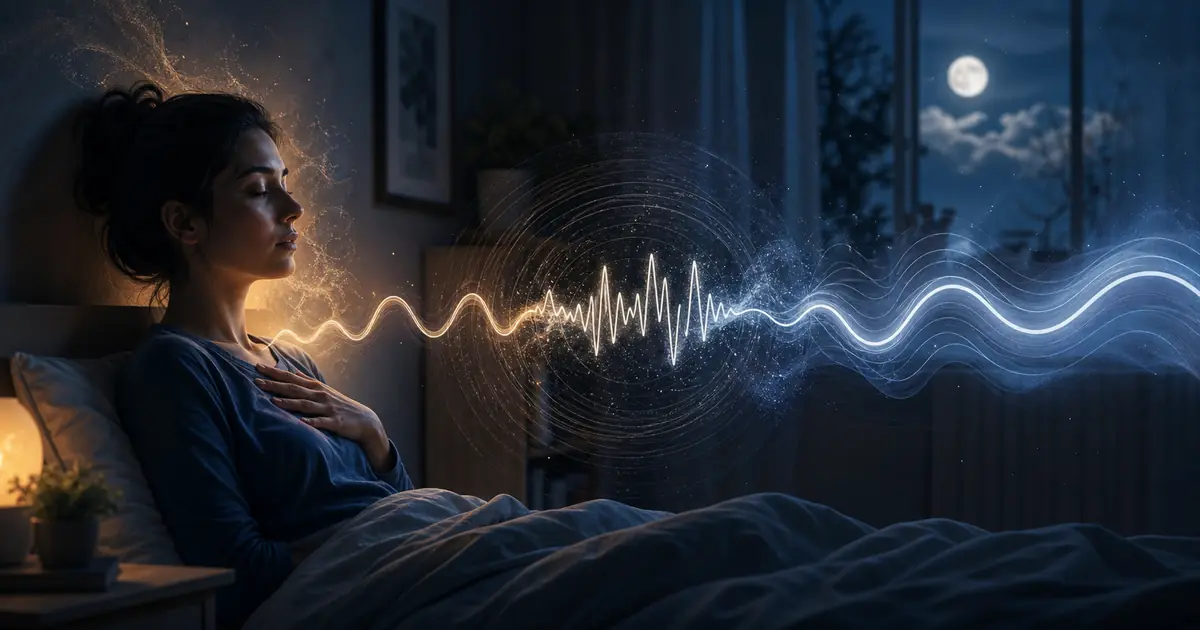
If breathing exercises make you more anxious at night, you are not doing them wrong. Breathwork helps many people, but for some insomnia patterns it increases body monitoring, control, and pressure.
The solution is not to force breathwork harder. The solution is to choose a tool that fits your nervous system.
Why breathwork can backfire
Breathing is close to anxiety.
When you focus on it, you may start checking:
- Am I breathing correctly?
- Is my chest too tight?
- Is my heart slowing down?
- Why am I not calmer yet?
- Did I hold too long?
- Am I getting enough air?
Now the exercise has become monitoring.
And monitoring is alerting.
The problem is not breathing. It is control.
Many insomnia patterns are maintained by control.
You try to control thoughts, sensations, timing, relaxation, and sleep itself.
Breathwork can help when it softens that control.
It can backfire when it becomes one more thing to perform.
This is why one person loves 4-7-8 breathing and another person feels trapped by the counting.
Signs breathwork may not be your best night tool
Breathwork may be a poor fit in the moment if:
- you start monitoring your heart rate
- you feel air hunger
- counting makes you tense
- you keep asking whether it is working
- you feel more responsible for forcing sleep
- your attention becomes stuck inside your chest or throat
That does not mean breathwork is bad.
It means tonight may need a different route.
What to try instead
Cognitive shuffling
If your mind needs something neutral to do, cognitive shuffling can work better than breath control.
Pick a word and imagine simple words beginning with each letter.
Keep it light. No story. No analysis.
External sound
Some people do better with attention outside the body.
Brown noise, pink noise, soft narration, or a personalized audio can give the mind a place to rest without forcing internal monitoring.
Paradoxical intention
Try gently allowing wakefulness:
I can stay awake quietly. I do not need to make sleep happen.
This can reduce the pressure to perform relaxation.
Body practices without breath control
If the body is tense, try:
- progressive muscle relaxation
- gentle pandiculation
- a warm bath earlier in the evening
- deep pressure if it feels comforting
- a broad body scan focused on heaviness, not precision
If you still want to use breathing
Make it simpler.
Instead of counting perfectly, try:
- breathe normally
- make the exhale a little longer
- stop if you feel more anxious
- do not check whether it is working
Breathing should feel like a gentle suggestion, not a job.
Get your free Personalized Sleep Expert Review
If common sleep techniques make you more anxious, that is exactly why personalization matters.
The free Personalized Sleep Expert Review helps identify your insomnia loop and gives you two audios matched to your answers.
Start your free Personalized Sleep Expert Review
Sources
- ACT for insomnia pilot randomized trial: https://pmc.ncbi.nlm.nih.gov/articles/PMC8555642/
- American Academy of Sleep Medicine, behavioral and psychological treatments for chronic insomnia: https://pmc.ncbi.nlm.nih.gov/articles/PMC7853203/
Get your free Sleep Expert Review
Personalized assessment, two downloadable audios, and a first CBT-I based recommendation for your pattern.
Start my free assessment