Sleep Anxiety
Is It Bad to Look at the Clock When You Cannot Sleep?
Written by Samuel Michelot. Reviewed by Pilar Hostaled, registered psychologist. · Last updated June 2026
Quick answer
Looking at the clock is not bad in itself, but it becomes a problem when it turns the night into a countdown that adds pressure, monitoring, and anxiety. The goal is not to be perfect about never seeing the time, it is to stop using the clock as a threat signal. The simplest fix is to turn the clock away so a normal waking stays boring.
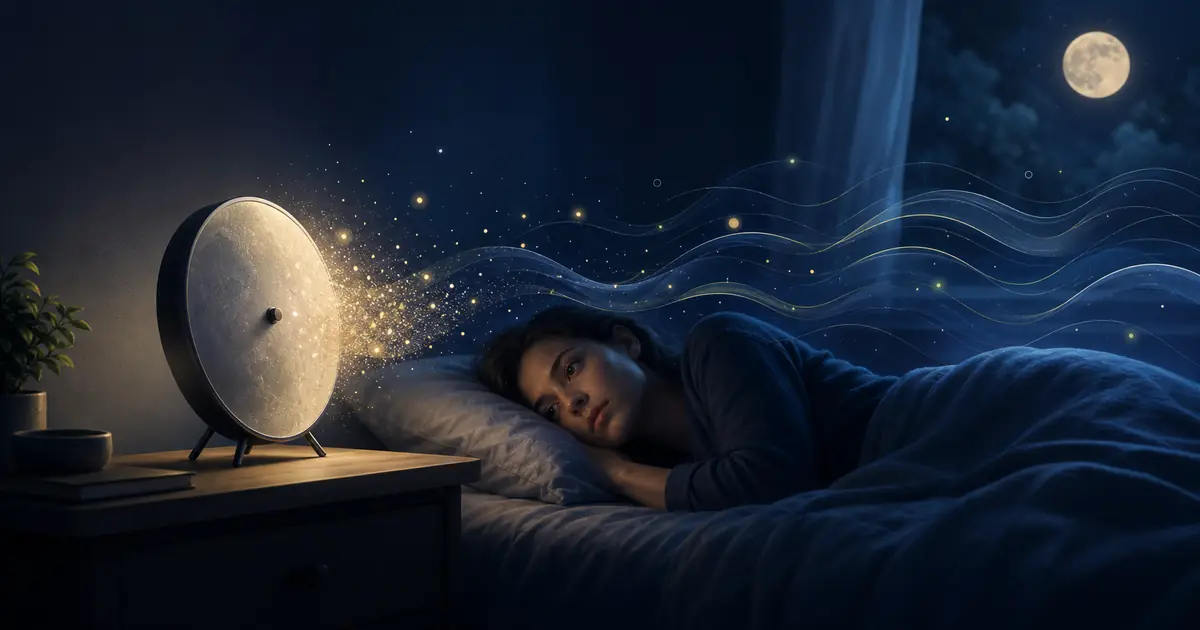
Looking at the clock is not morally bad. It becomes a problem when it turns the night into a countdown: “Only five hours left”, “Now four”, “Tomorrow is ruined.” For many people with insomnia, clock checking adds pressure, monitoring, and anxiety, which can make sleep harder to return to.
The goal is not to become perfect about never seeing the time. The goal is to stop using the clock as a threat signal.
Why clock watching can keep you awake
Sleep is easier when the nervous system feels safe enough to let go. Clock watching often does the opposite.
You wake up, see the time, calculate how many hours are left, imagine tomorrow, and start testing whether sleep is coming back. That turns wakefulness into a performance review.
The body hears: something important is going wrong.
That signal can increase arousal, even if you are exhausted.
The clock does not create insomnia by itself. The problem is the chain reaction after you see it.
The usual clock-checking loop
For many insomnia patterns, the loop looks like this:
- You wake up during the night.
- You check the time.
- You calculate the hours left.
- You predict how bad tomorrow will be.
- You try harder to sleep.
- Your mind monitors whether it is working.
- Monitoring keeps you alert.
This is why clock checking is often linked with trying harder to sleep. The more urgent sleep becomes, the less automatic it feels.
What to do tonight
Try a simple experiment for one week:
- turn the clock away from the bed
- put your phone out of reach
- use an alarm you trust
- if you wake up, do not calculate the night
- ask, “Am I resting, or am I struggling?”
If you are resting, stay quiet and let the night continue.
If you are struggling, change the state: sit up, use a calm audio, read something neutral in dim light, or leave the bed briefly until the pressure drops.
You do not need the exact time to make that decision.
What if you need the alarm?
Most people do need an alarm. That is fine.
The practical move is to separate “alarm” from “night scoreboard”:
- set the alarm before bed
- place it where you cannot read it easily
- keep the screen dark
- do not unlock your phone to check it
- avoid sleep tracker screens during the night
If your mind says, “But I need to know”, notice that as part of the insomnia loop. Knowing the time rarely helps at 3am. It usually gives anxiety more numbers to work with.
What to avoid
Avoid turning this into another strict rule.
If you accidentally see the time, the night is not ruined. Do not start thinking, “Now I failed.” That is just another form of performance pressure.
Also avoid:
- calculating sleep in bed
- checking a wearable sleep score at night
- searching insomnia articles from bed
- using the clock to decide whether tomorrow is lost
- moving bedtime earlier and earlier to compensate
If your mind keeps racing, you may also like this article: What to Do When You Cannot Sleep and Your Mind Will Not Stop.
When clock watching is a sign of a bigger pattern
Clock watching is often not the whole problem. It may be a sign of:
- sleep anxiety
- irregular wake times
- too much time in bed
- a bad night recovery cycle
- fear of work performance
- health anxiety
- low trust in the body
In that case, hiding the clock can help, but it may not be enough. You may need a broader plan based on CBT-I principles, sleep pressure, stimulus control, and anxiety around wakefulness.
Medical caution
Ask a clinician for guidance if insomnia has lasted for months, is affecting your ability to function, or comes with loud snoring, breathing pauses, gasping, morning headaches, severe daytime sleepiness, restless legs, significant mood symptoms, pain, medication changes, pregnancy, menopause symptoms, or another health change.
The NHS notes that long-term insomnia can affect daily life and may need professional support. NHLBI also lists insomnia and frequent night waking among possible sleep apnea symptoms, especially when they appear with snoring, gasping, or daytime fatigue.
Get your free Personalized Sleep Expert Review
If checking the time has become part of your night, your pattern matters.
The free Personalized Sleep Expert Review helps identify your insomnia loop and gives you two audios matched to your answers.
Start your free Personalized Sleep Expert Review
Sources
- American Academy of Sleep Medicine, behavioral and psychological treatments for chronic insomnia: https://pmc.ncbi.nlm.nih.gov/articles/PMC7853203/
- NHS, Insomnia: https://www.nhs.uk/conditions/insomnia/
- NHLBI, Sleep Apnea Symptoms: https://www.nhlbi.nih.gov/health/sleep-apnea/symptoms
Get your free Sleep Expert Review
Personalized assessment, two downloadable audios, and a first CBT-I based recommendation for your pattern.
Start my free assessment