Sleep Anxiety
How to Stop Calculating Sleep Hours at Night
Written by Samuel Michelot. Reviewed by Pilar Hostaled, registered psychologist. · Last updated August 2026
Quick answer
You calculate sleep hours because your brain is trying to predict and control a bad day, but the math itself raises alarm and keeps you awake. Stop feeding it: hide the clock, drop the target number, and let the night be undefined. The aim is to make the waking boring, not solved.
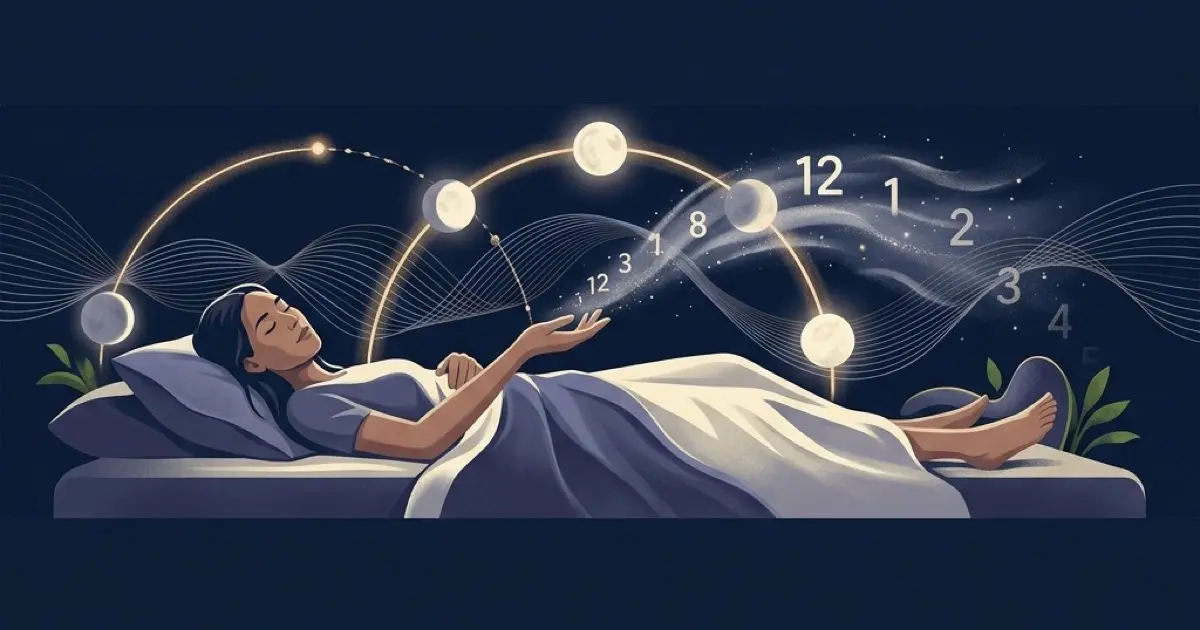
You wake in the night and the calculator switches on. It is 3:14, if I sleep now I get four hours and forty-six minutes, but I won’t fall asleep instantly so really it is more like four hours, and four hours is not enough, so tomorrow will be bad. Sound familiar? This counting feels like planning, but it is one of the most reliable ways to push sleep further away.
The math is your brain trying to control an uncertain night. The problem is that doing it requires alertness, time-checking, and worry, which are exactly the ingredients of being awake.
Why counting keeps you awake
Every calculation needs a clock check and a judgment, and each judgment carries a small jolt of stress. That stress raises arousal, and arousal is incompatible with sleep. You are, in effect, repeatedly waking yourself up to measure how awake you are. The target number, often eight hours, makes it worse, because falling short feels like failure before the night is even over.
What to do tonight
Remove the feedback the math needs. Turn the clock away or cover it so you cannot check the time. Decide in advance that you will not calculate, and when the thought starts, label it (“there is the counting”) and return your attention to something neutral like the feel of the bed or slow, unforced breathing. Let the night be undefined. You do not need to know how many hours you will get; you only need to rest.
If you are wide awake and tense, get up, sit somewhere dim and calm, and go back when sleepy. Resting without counting is the goal, whether or not sleep comes quickly.
What to avoid
Avoid clocks you can see from bed, including your phone. Avoid setting an hours target. Avoid bargaining with the night (“if I sleep by 3:30 I’ll be ok”), since every bargain is another calculation.
When to talk to a clinician
If the counting is part of broader anxiety that fills your days, or insomnia has lasted months, a clinician trained in CBT-I or ACT can help you loosen the need to control sleep.
Sources
- American Academy of Sleep Medicine, behavioral and psychological treatments for chronic insomnia: https://pmc.ncbi.nlm.nih.gov/articles/PMC7853203/
- NHS, Insomnia: https://www.nhs.uk/conditions/insomnia/
- Sleep Foundation, what to do when you cannot sleep: https://www.sleepfoundation.org/insomnia/treatment/what-do-when-you-cant-sleep
Get your free Sleep Expert Review
Personalized assessment, two downloadable audios, and a first CBT-I based recommendation for your pattern.
Start my free assessment