Sleep Techniques
Why Meditation Makes My Insomnia Worse
Written by Samuel Michelot. Reviewed by Pilar Hostaled, registered psychologist. · Last updated June 2026
Quick answer
Meditation can make insomnia worse when it turns attention inward in a way that increases monitoring, body anxiety, or pressure to relax. That does not mean meditation is bad, it means your nervous system may need a different night practice. A technique only helps if it lowers arousal, not if it becomes another test you have to pass.
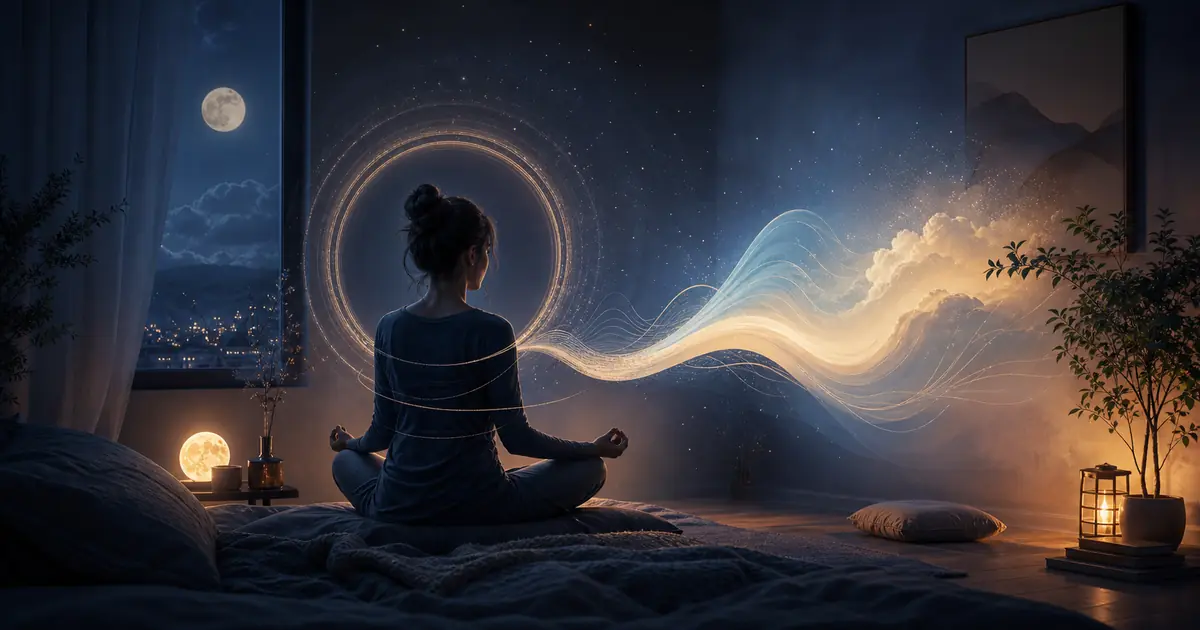
Meditation can make insomnia worse if it turns your attention inward in a way that increases monitoring, body anxiety, or pressure to relax. That does not mean meditation is bad. It means your nervous system may need a different kind of night practice.
For sleep, the question is not “Is meditation good?” The better question is: “Does this specific practice reduce arousal for me tonight?”
Why meditation can backfire at night
Many sleep meditations ask you to notice the breath, scan the body, or observe thoughts. For some people, that is calming.
For others, especially during insomnia, it can intensify the very things they are trying to escape:
- heartbeat awareness
- breathing control
- body scanning
- intrusive thoughts
- fear of not relaxing
- checking whether the technique is working
If you are already anxious, turning attention inward can become another form of monitoring.
A sleep technique is helpful only if it lowers pressure. If it becomes a test, it may feed insomnia.
The “trying to meditate correctly” problem
Meditation can accidentally become sleep effort.
You lie down and think:
- “Am I relaxed yet?”
- “Why is my mind still active?”
- “I am bad at meditation.”
- “If this does not work, I will not sleep.”
- “Maybe I need a longer meditation.”
Now the practice has become another performance. This is close to the loop described in Why Trying Harder to Sleep Makes Insomnia Worse.
Sleep usually does not respond well to performance pressure.
Which meditation styles are more likely to backfire?
It depends on the person, but these can be tricky during insomnia:
| Practice | Why it can backfire |
|---|---|
| Breath-focused meditation | Can increase breathing control or air hunger anxiety |
| Body scan | Can amplify sensations, pain, heartbeat, or tension |
| Long silent meditation | Can leave too much space for rumination |
| ”Empty your mind” meditation | Can create frustration when thoughts continue |
| Sleep hypnosis with strong promises | Can create pressure if you are still awake |
What to do instead tonight
Try switching from inward focus to light outward focus.
Options:
- listen to a neutral story
- use cognitive shuffling
- count ordinary objects in a category
- play calm rain or low-volume sound
- read something mildly boring in dim light
- use a guided audio that gives you permission to stay awake
The aim is not to produce a spiritual state. The aim is to make wakefulness less threatening.
If your mind is racing, this may help: What to Do When You Cannot Sleep and Your Mind Will Not Stop
A gentler way to meditate for sleep
If you still want to use meditation, make it lighter:
- keep it short, around 5 to 10 minutes
- choose a voice that feels safe and simple
- avoid intense body scanning when anxious
- avoid forcing slow breathing
- allow thoughts without trying to erase them
- stop if the practice increases panic
Use meditation as an invitation, not a command.
Try this phrase:
I am not meditating to make sleep happen. I am giving my mind somewhere gentle to rest.
That small shift matters.
What not to do
Avoid stacking more techniques when the first one fails.
One common insomnia pattern is:
- Try meditation.
- Check if sleep is coming.
- Try breathing.
- Check again.
- Try a body scan.
- Check again.
- Panic because nothing worked.
This keeps the mind active. Choose one low-pressure practice, then let it be enough.
Medical caution
Meditation and mindfulness are usually low risk, but they are not perfect for everyone. NCCIH notes that research on potential harms is limited and that negative experiences can occur, with anxiety and depression among commonly reported negative effects in one review.
Get professional support if meditation triggers panic, dissociation, trauma memories, frightening experiences, severe anxiety, worsening depression, or thoughts of self-harm. Do not use meditation as a replacement for medical or mental health care.
Also ask a clinician about insomnia that lasts for months, strongly affects daytime functioning, or appears with snoring, breathing pauses, severe daytime sleepiness, pain, medication changes, pregnancy, menopause symptoms, or another health issue.
Get your free Personalized Sleep Expert Review
If meditation, breathwork, or relaxation keeps backfiring, you probably do not need more discipline. You need a better match.
The free Personalized Sleep Expert Review helps identify your insomnia loop and gives you two audios matched to your answers.
Start your free Personalized Sleep Expert Review
Sources
- NCCIH, Meditation and Mindfulness: Effectiveness and Safety: https://www.nccih.nih.gov/health/meditation-and-mindfulness-effectiveness-and-safety
- American Academy of Sleep Medicine, behavioral and psychological treatments for chronic insomnia: https://pmc.ncbi.nlm.nih.gov/articles/PMC7853203/
- NHS, Insomnia: https://www.nhs.uk/conditions/insomnia/
Get your free Sleep Expert Review
Personalized assessment, two downloadable audios, and a first CBT-I based recommendation for your pattern.
Start my free assessment