CBT-I
Should I Get Out of Bed If I Wake Up in the Middle of the Night?
Written by Samuel Michelot. Reviewed by Pilar Hostaled, registered psychologist. · Last updated September 2026
Quick answer
Getting out of bed at 3am can help some insomnia patterns, but it can backfire if it becomes rigid or stressful. Here is how to adapt the CBT-I rule.
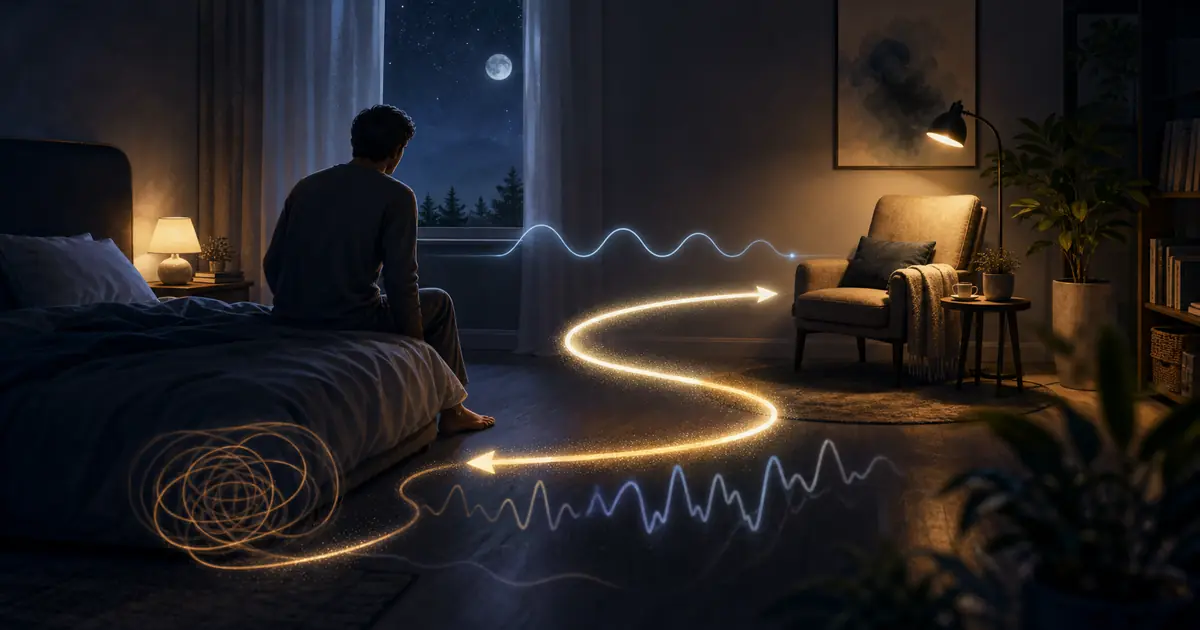
If you wake up at 3am and cannot fall back asleep, getting out of bed can help when you feel alert, frustrated, or trapped. But it is not a punishment and it should not become another rigid rule that makes the night more stressful.
The real goal is to protect the association between bed and sleep.
Why CBT-I often says to get out of bed
In CBT-I, this is usually part of stimulus control.
The idea is simple: if you spend hours awake in bed worrying, checking the time, or trying to force sleep, your brain can learn that bed means wakefulness.
Getting out of bed breaks that association.
You leave the place of struggle, do something quiet, and return when sleepiness comes back.
Over time, the bed becomes a cue for sleep again.
When getting out of bed helps
It may help if:
- you feel wide awake
- you are frustrated
- you are checking the clock
- you are replaying tomorrow
- you feel trapped in bed
- you have been awake long enough that bed feels like a battleground
In those cases, staying in bed may strengthen the insomnia loop.
When it can backfire
Getting out of bed can backfire if you turn it into a harsh rule.
For example:
- “It has been 20 minutes, I must leave right now.”
- “If I stay, I am failing CBT-I.”
- “Now I will be cold and awake for hours.”
- “This rule is ruining my night.”
If the instruction creates panic, it needs to be adapted.
Good sleep work should reduce struggle, not add a new layer of obedience.
A gentler decision rule
Instead of watching the clock, ask:
Am I resting, or am I struggling?
If you are resting, you may stay in bed.
If you are struggling, leave briefly.
This is often more useful than counting exact minutes.
What to do if you get out of bed
Keep it boring.
Good options:
- sit in a dim room
- read something neutral
- listen to a calm audio
- do a quiet body-based practice
- write one short note if your mind is stuck on a task
Avoid:
- phone scrolling
- bright lights
- work email
- researching insomnia
- intense cleaning
- dramatic journaling
You are not starting a second day. You are waiting for sleepiness to return.
What if you never feel sleepy?
This is where personalization matters.
If you repeatedly get out of bed and never feel sleepy, the problem may involve:
- too much time in bed
- irregular wake times
- low sleep pressure
- sleep anxiety
- caffeine timing
- naps
- alcohol
- medication
- another sleep or medical issue
The rule alone is not the whole treatment.
It needs to be part of a plan.
Get your free Personalized Sleep Expert Review
If you are unsure whether to stay in bed or get up at 3am, your pattern matters.
The free Personalized Sleep Expert Review helps identify your insomnia loop and gives you two audios matched to your answers.
Start your free Personalized Sleep Expert Review
Sources
- American Academy of Sleep Medicine, behavioral and psychological treatments for chronic insomnia: https://pmc.ncbi.nlm.nih.gov/articles/PMC7853203/
- American Academy of Sleep Medicine systematic review for behavioral and psychological treatments: https://pmc.ncbi.nlm.nih.gov/articles/PMC7853211/
Get your free Sleep Expert Review
Personalized assessment, two downloadable audios, and a first CBT-I based recommendation for your pattern.
Start my free assessment